A rope’s length away
Ronja, the Robber's Daughter“A rope’s length away” is a recurring expression that turns Ronia’s attempt to keep Birk at a distance into an image of the bond between them. First imposed as a limit while they travel through dangerous woods, it returns in the blizzard when Birk rescues her and follows her home: the distance remains, but now it makes companionship possible rather than forbidding it.
The Rule in the Mist
When Birk admits that the mist frightens him, Ronia teases him about being afraid he will not get home to his thieving people. Birk laughs at her toughness, then acknowledges that she knows the way to Matt’s Fort better than he does and asks whether he may hold the edge of her tunic until they leave the woods. Ronia refuses that intimacy, but does not leave him to find his way alone. Instead, she unties her leather rope—the same one that had saved him before—and hands him one end.
Her terms are explicit: “Here! But you’d better keep a rope’s length away from me—I’m warning you!” The rope gives Birk a practical connection to a guide while preserving the separation Ronia demands. The arrangement is both assistance and boundary: she takes responsibility for getting them through, but will not let him hold on to her clothing or walk close beside her.
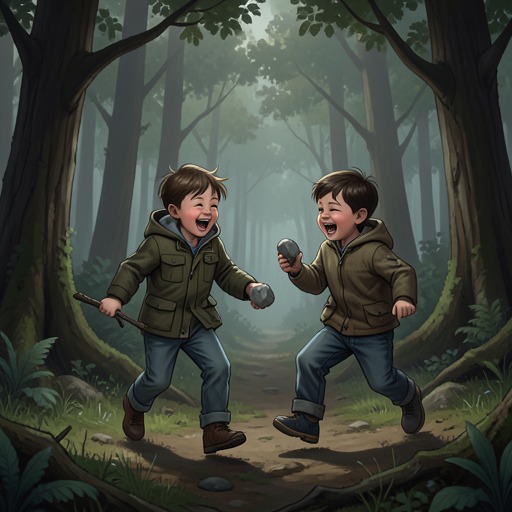
They proceed through the fog in silence, a rope’s length apart, as she has decreed. They must stay on the path, where even a wrong step could lead them astray. Ronia feels her way forward with her hands and feet, reading stones, trees, and bushes as signposts; she expects to reach home before Lovis sings the Wolf Song. Yet familiarity does not make the journey wholly safe. The woods seem unnaturally silent, and the unknown presence in the mist frightens her. The rope thus joins two travelers who are each vulnerable to the obscured forest, even as its measured length preserves Ronia’s chosen space.
Rescue and Reversal
The expression returns in a different kind of peril during the blizzard, when Ronia is trapped in a hole among the rumphobs. Birk has found her ski at the bottom, and when he bends to lift her, she clings to him and cries, “Don’t leave me! Don’t ever leave me again!” Her desperate appeal overturns the earlier pose of firm distance: at the moment she fears being left alone, she reaches for the very person she has repeatedly kept at arm’s length.
Birk answers by smiling and recalling her rule: “No, as long as you keep a rope’s length away! Let go of me and stop howling and I’ll see if I can get you free.” The line turns the earlier warning into affectionate teasing, but does not make light of the danger. He takes off his skis, lies beside the hole, and works at freeing her until she can pull her leg up. In this scene, the remembered distance sits beside practical closeness: Birk must get near enough to reach into the hole, while their old phrase gives shape to a relationship in which care and independence coexist.
The Rope on the Homeward Journey
After her rescue, Ronia says she has to try to get home and asks Birk to come too. He agrees. She skis painfully down the slope through the swirling snow, with Birk following behind her a rope’s length away. Again and again, she checks that he is still there, afraid that he will suddenly disappear and leave her alone. The measure that once expressed her insistence on separation now accompanies her need for his continued presence.
Their shared journey lasts until they are nearly at Wolf’s Neck. There they have to part: Ronia is going home, while Birk will take a secret way back to Borka’s Keep. They stand silently in the falling snow, unable to say goodbye easily. Ronia wants with all her strength to keep him there, a striking contrast with the earlier warning that he must stay away from her. Her wish that he were her brother gives explicit form to the attachment that the rope’s length has carried without erasing their separate homes or the need to part.
Meaning and Recurrence
The phrase’s meaning changes through repetition rather than through the disappearance of its original boundary. In the fog, Ronia chooses the distance and sets the terms of their movement; in the blizzard, Birk invokes the same rule as he rescues her; on the journey home, the distance persists while Ronia anxiously checks that he remains behind her. The recurring measure links wary companionship, rescue, and reluctant separation.
The rope itself is more than an image. It is Ronia’s leather rope, a useful object that had previously saved Birk and that she now gives him so they can travel through the fog. Its length allows connection without contact, making the expression a concrete description of how they move through danger together. The refrain does not claim that their differences or circumstances have vanished: they still leave by separate routes and return to different keeps. Instead, it gives their developing trust a precise form—close enough to follow and help, yet still a rope’s length apart.